
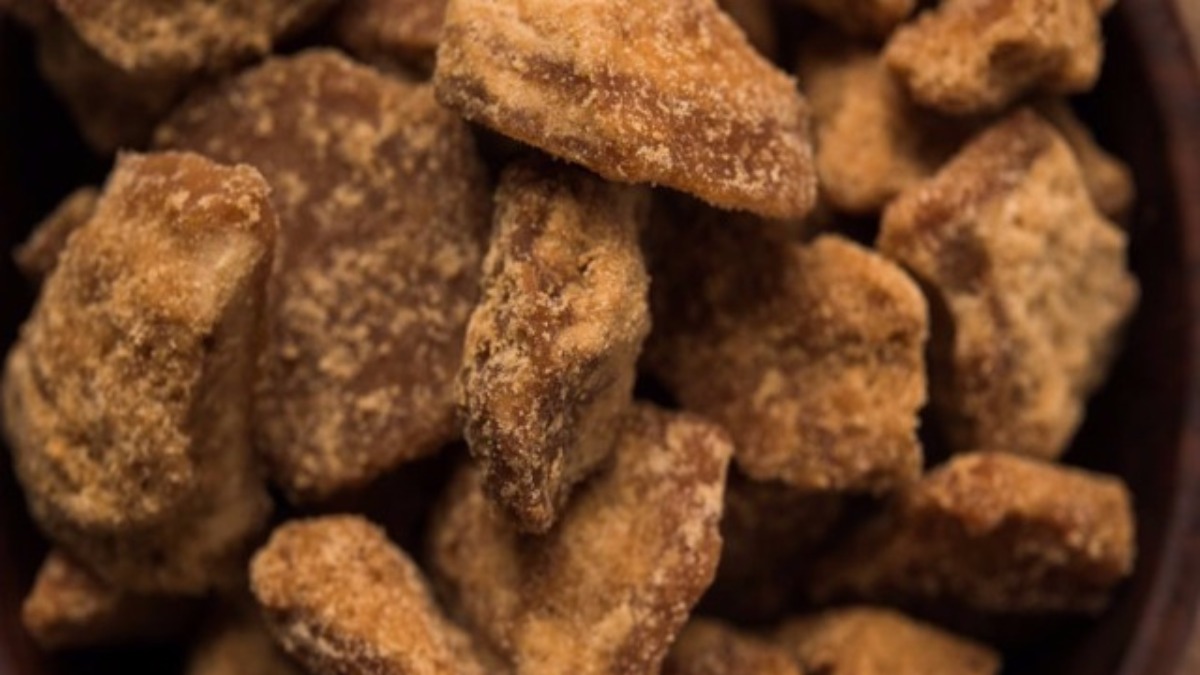
Gur or Jaggery is an integral part of our Indian cuisine. Jaggery is a naturally sweetening food with enormous health benefits. Made primarily from raw, concentrated sugarcane juice that is boiled until it solidifies, it is essentially a type of unrefined sugar. It is used in making some curries, Kheer, Ladoos, Puranpoli and the famous tilgul for Sankranti festival in India.
In the southern part of India Jaggery is used in making Paysam, Chakkara Pongal, a desert made from rice and milk.
Many also use Jaggery in their daily tea and coffee.
Health experts and elders always say Jaggery should be consumed more in winter as it produces heat. In the hot summer season it is better to avoid it.
It is also considered to be a natural sweeter which can substitute white sugar.
it can be made from date palm (Nolen Gur of West Bengal) or the sap of coconut too.
Constitution of Jaggery
Just 20 grams of it contains 38 calories and has 9.8 gram of carbohydrates, 9.7 gram of sugar, 0.01 gram of protein, choline, betaine, Vitamin B12, B6, folate, calcium, iron, phosphorus, magnesium, selenium, and manganese. It has no traces of any kind of fat so one can readily add it to their diet without worrying about excessive fat intake.
Diabetic patients can use it in small portion. Though, it is a better alternative than sugar, the truth is that it too contains high levels of sugar. There is almost 65 per cent-85 per cent of sucrose in 10 grams of Jaggery. Therefore, people with diabetes are advised to not consume it regularly.
Numerous health professionals recommend replacing sugar with Jaggery to obtain greater nutritional values from a sweetener. While both may be processed, sugar is mainly in the form of translucent, white crystals while Jaggery can either be golden brown or dark brown in colour.
But one has to remember that it is essentially still sugar and extra nutrients may come with a lot of calories. It is best consumed in moderation.
How is Jaggery produced?
Sugarcane juice is boiled for quite a few hours before adding it in the moulds and is further kept to cool off and let it harden. On the other hand, white sugar has to go through crystallization and several other processes in before it is packaged for consumption. Sugar undergoes rigorous industrial processes, such as treatment with charcoal, due to which its nutritional value is lost.
It is a three step process
Extraction: The canes or palms are pressed to extract the sweet juice or sap.
Clarification: The juice is allowed to stand in large containers so that any sediment settles to the bottom. It is then strained to produce a clear liquid.
Concentration: The juice is placed in a very large, flat-bottomed pan and boiled.
Sugar undergoes no excessive treatment except the boiling of sugarcane syrup. This ensures the retention of traces of iron, mineral salts and fiber in it. These minerals and plant phytochemicals are useful remedies for several ailments.
Before buying Gur make sure it has the right colour, texture and hardness. Also, it is imperative that you check the purity of the product before buying it. Many a times, artificial colours and chalk powder are added
The Health Benefits of Jaggery
*This natural sweetener is an effective way to boost immunity and regulate body temperature.
* It enriches the skin, improves digestion and cures joint pain, apart from a number of other mind-blowing health benefits.
* it facilitates quick digestion since it is rich in nutrients. Moreover, it flushes out toxins from the body and cleanses the blood as well. The nutrients help to maintain electrolyte balance, thereby improving metabolism and the presence of potassium enables water retention.
Sugarcane jaggery is made from unfilter sugarcane juice, which makes it a not-so healthy choice for weight watchers and diabetics.
Whereas coconut jaggery is a great source of antioxidants and minerals like iron, folate and magnesium and is considered to be a better and a much healthier option as compared to sugarcane jaggery.
On the other hand palm jaggery is not only packed with nutrients like iron, folate, potassium and calcium, it also has the lowest glycemic index and is a proven remedy against cough and cold. It is much healthier option than sugarcane jaggery, but to reap the benefits make sure you consume it in moderation.

